How Do AI Detectors Work? The Science Behind Tools Like GPTZero
Every week, a new headline talks about AI-written essays fooling teachers. At the same time, students post screenshots of their own human writing flagged as fake. This confusion raises one simple question: how do AI detectors work in the first place?
Understanding how AI detectors work is not just a tech curiosity anymore. It affects grades, job applications, and even legal documents. If you are a student, teacher, writer, or editor, knowing what happens behind the scenes can save you from real trouble.
This article breaks down how AI detectors work, in plain language, without the confusing math. By the end, you will understand exactly what these tools measure, why they sometimes get it wrong, and how to use their results wisely.
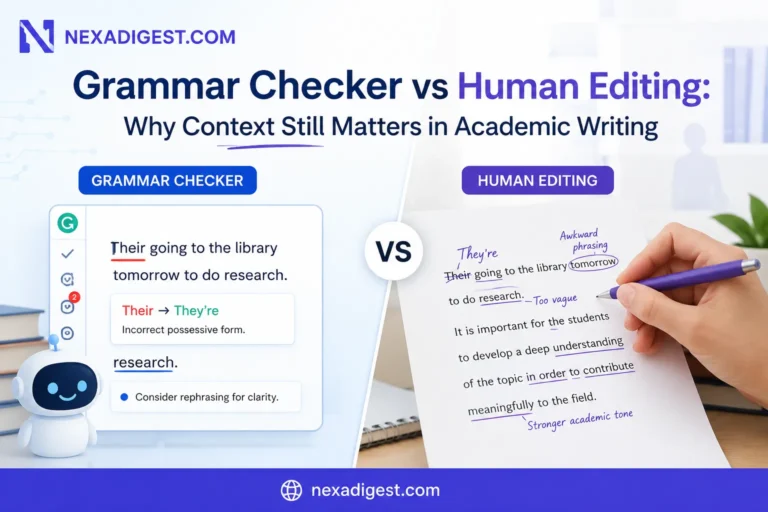
Also Read :: Grammar Checker vs Human Editing: Why Context Still Matters in Academic Writing
Table of Contents
What Is an AI Detector, Really?
An AI detector is a tool that scans a piece of text and predicts whether a human or an AI model wrote it. Tools like GPTZero, Originality.ai, and Turnitin’s AI writing indicator all fall into this category.
But here is the key point: no AI detector can know for certain who wrote something. Instead, every AI detector works by measuring patterns in the writing and comparing them to patterns common in AI-generated text. The result is a probability score, not a fact.
This distinction matters a lot. A high score means the writing looks similar to AI output. It does not mean AI definitely wrote it.
The Two Core Concepts: Perplexity and Burstiness
Most AI detectors, including GPTZero, rely on two main ideas to measure how “AI-like” a piece of text feels. Understanding these two concepts is the real answer to how AI detectors work.
1. Perplexity: How Predictable Is the Text?
Perplexity measures how surprising or predictable each word choice is, based on what usually comes next in a sentence.
AI language models are trained to predict the most statistically likely next word. So when AI writes, it tends to choose safe, common, expected words. This creates low perplexity, meaning the text is smooth and predictable.
Human writers, on the other hand, make less predictable choices. We use odd phrases, unusual comparisons, and sentence structures that don’t always follow the “expected” path. This creates higher perplexity.
So when an AI detector calculates perplexity, it is really asking: “How boring and predictable is this word sequence, statistically speaking?” Low perplexity often points toward AI-generated text.
2. Burstiness: How Much Does Sentence Style Vary?
Burstiness looks at variation across a whole piece of writing, not just single words.
Human writing naturally goes up and down in rhythm. We write a long, detailed sentence, then follow it with something short. We change our pace depending on mood, emphasis, or topic. This creates high burstiness.
AI-generated text, especially from earlier and mid-generation models, tends to keep a steady, even rhythm. Sentences stay similar in length and structure throughout the passage. This creates low burstiness.
When AI detectors combine perplexity and burstiness, they build a mathematical fingerprint. Text with low perplexity and low burstiness gets flagged as likely AI-generated. Text with higher, more irregular patterns gets scored as more likely human.
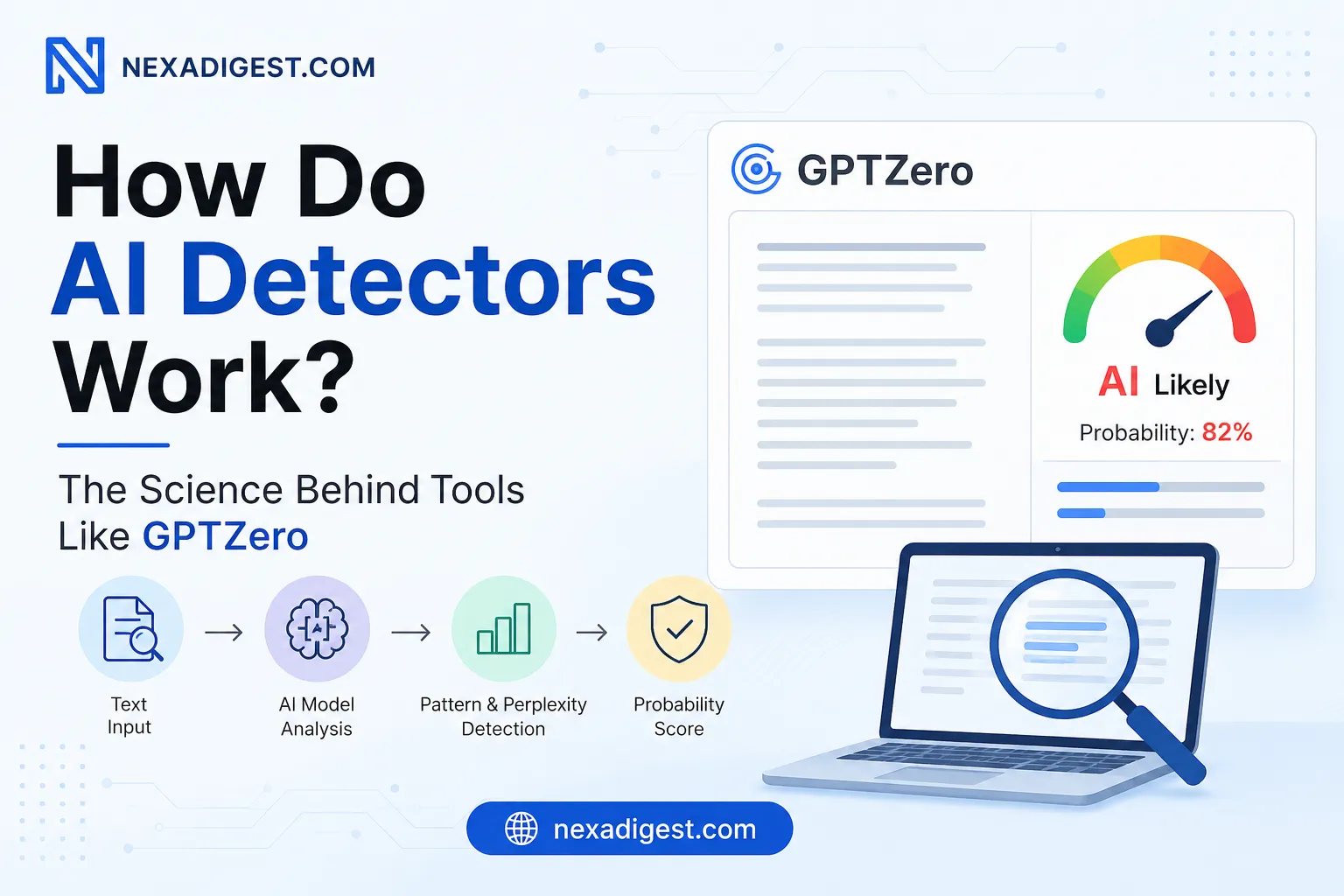
Step by Step: How an AI Detector Processes Your Text
To fully understand how AI detectors work, it helps to walk through the actual process.
- Text Input: You paste or upload your writing into the tool.
- Tokenization: The tool breaks the text into small units called tokens, usually parts of words or whole words.
- Pattern Analysis: The detector’s internal model compares your token sequence against patterns learned from large datasets of both human and AI writing.
- Scoring: The tool calculates perplexity and burstiness scores for each sentence and the document overall.
- Classification: Based on these scores, the detector labels sections of your text as “likely AI,” “likely human,” or “mixed.”
- Report Generation: Most tools, including GPTZero, generate a visual report highlighting specific sentences that triggered the AI flag.
This entire process happens in seconds, but the underlying calculation involves comparing your text against millions of examples the model was trained on.
Why AI Detectors Sometimes Get It Wrong
No discussion of how AI detectors work is complete without talking about false positives. This is where a detector wrongly flags human writing as AI-generated.
False positives happen for several real reasons:
- Non-native English writers often use more formal, predictable sentence structures, which can mimic low burstiness.
- Technical or academic writing naturally uses repetitive structure and formal vocabulary, lowering perplexity.
- Heavily edited human writing can lose its natural burstiness once a writer smooths out awkward phrasing.
- Short text samples don’t give the detector enough data to measure patterns accurately.
Because of these limitations, major testing organizations, including OpenAI itself, have acknowledged that AI detectors are not reliable enough to be used as the sole basis for serious academic or professional decisions.
Are AI Detectors Accurate?
Accuracy varies a lot between tools, and it changes constantly as AI models improve. When GPT-3 first appeared, detectors performed reasonably well because AI text had very distinct patterns. As models like GPT-4 and newer versions became better at varying sentence structure, detection accuracy dropped.
Most independent studies show AI detectors range from 60 percent to 85 percent accuracy on average, with false positive rates that concern educators and writers alike. This is exactly why understanding how AI detectors work, rather than blindly trusting the score, matters so much.
How to Use AI Detector Results Responsibly
If you are a teacher, editor, or manager reviewing flagged content, keep these points in mind:
- Treat the score as a starting point, not a verdict. A 70 percent AI score should prompt a conversation, not an automatic penalty.
- Look at the flagged sentences specifically. Sometimes only one paragraph triggers the flag, while the rest reads clearly human.
- Consider the writer’s background and writing history. Compare the flagged piece to previous work from the same person.
- Combine multiple tools if the decision is high stakes. No single detector should carry the full weight of a serious accusation.
If you are a student or writer worried about false positives, write in your natural voice, vary your sentence length, and avoid over-editing your work into robotic uniformity.
A Short History: How AI Detection Technology Evolved
To fully appreciate how AI detectors work today, it helps to look at where they started.
When GPT-2 launched, OpenAI released one of the first public AI detectors alongside it. That early tool was fairly effective because GPT-2 text had obvious statistical patterns. Sentences repeated structure often, and vocabulary stayed narrow.
As GPT-3 and later models arrived, text generation became more varied and human-like. Detection tools had to adapt. This is when perplexity and burstiness scoring became the industry standard, since simple keyword or phrase matching no longer worked.
GPTZero, launched by a Princeton student in early 2023, became one of the most widely used detectors in education specifically because it explained its scoring method openly. Instead of just giving a percentage, it highlighted sentence-by-sentence perplexity, which helped teachers understand how AI detectors work rather than just trust a black-box number.
Since then, detection tools have added more layers, including watermark detection (looking for hidden statistical signatures some AI companies embed in outputs) and stylometric analysis, which studies a writer’s personal patterns over time.
How Different Tools Approach Detection Differently
Not every AI detector works the same way, even though most rely on perplexity and burstiness as a foundation. Here is how a few popular tools differ in approach:
- GPTZero focuses heavily on sentence-level perplexity and burstiness, presenting a visual heatmap so users can see exactly which sentences triggered flags.
- Originality.ai combines pattern detection with a large database of known AI outputs, useful for publishers checking large volumes of content at once.
- Turnitin’s AI writing indicator integrates detection directly into existing plagiarism-checking workflows used by universities, scoring documents as a percentage of likely AI-generated content.
- Copyleaks adds multilingual detection, since perplexity patterns can shift significantly across different languages.
Despite these differences, the underlying question every tool tries to answer stays the same: does this text follow statistically predictable AI patterns, or does it show the natural irregularity typical of human writing?
Why Understanding This Matters for Everyday Writers
Knowing how AI detectors work is not only useful for students facing accusations. It matters for several other groups too.
Freelance writers and content creators increasingly get asked by clients to prove their work is human-written, especially in industries like journalism, education content, and marketing. Understanding what triggers a flag helps writers avoid unnecessary disputes.
Teachers and professors need this knowledge to interpret detection reports fairly instead of treating a percentage score as absolute proof. A responsible educator uses the score as one signal among several, not a final verdict.
HR departments and hiring managers now sometimes run AI detectors on cover letters or writing samples. Understanding the technology’s real limitations prevents unfair rejection of a qualified candidate whose writing style simply happens to score lower on burstiness.
Editors and publishers rely on these tools to maintain content standards, but need to know when a false positive is likely so they don’t damage a trusted writer relationship over a flawed score.
Common Myths About How AI Detectors Work
Several misconceptions continue to spread about AI detection, and clearing them up is part of understanding how AI detectors work correctly.
Myth 1: AI detectors can prove someone used AI.
In reality, every detector produces a probability score, not proof. Courts, universities, and employers should never treat a detection score as definitive evidence on its own.
Myth 2: Paraphrasing tools can fully bypass detection.
While rewording can lower detection scores temporarily, many modern detectors are trained to catch paraphrased AI text too, since paraphrasing tools often still produce unusually smooth, low-burstiness sentences.
Myth 3: A 0 percent AI score guarantees human writing.
Some human writing, especially technical or formulaic content, can score as AI-generated simply because it shares similar low-perplexity characteristics. A low score is reassuring, but not an absolute guarantee either way.
Myth 4: All AI detectors use the same method.
As shown earlier, tools vary in their exact scoring approach, dataset size, and additional features like watermark detection, so results can differ noticeably between platforms for the same piece of text.
What the Future Holds for AI Detection
As AI writing models continue improving their ability to vary sentence rhythm and word choice, pure perplexity and burstiness scoring will likely become less reliable on its own. Detection companies are already exploring additional layers, including:
- Watermarking at the model level, where AI companies embed subtle, undetectable-to-humans patterns directly into generated text that detectors can later identify with higher confidence.
- Behavioral and metadata analysis, tracking how a document was created, including typing speed, edit history, and revision patterns, rather than only analyzing the final text.
- Personalized stylometric baselines, where a detector compares new writing against a specific student or writer’s established personal style over time, rather than comparing against a generic human-versus-AI dataset.
These developments suggest that understanding how AI detectors work will keep changing as an ongoing conversation, not a fixed, one-time lesson.
Frequently Asked Questions
Can AI detectors be 100 percent accurate? No AI detector, including GPTZero, claims perfect accuracy. Every tool produces a probability score with a real margin of error on both sides.
Do AI detectors store the text I submit? This depends on the specific tool’s privacy policy. Always check before submitting sensitive or unpublished academic work.
Why did my human-written essay get flagged as AI? This usually happens due to formal writing style, short sentence length uniformity, or heavy editing that reduced natural burstiness in your original writing.
Should schools rely only on AI detector scores for academic integrity cases? Most experts recommend against this. A responsible policy uses detection scores as one input alongside teacher judgment, writing history, and a direct conversation with the student.
The Bigger Picture
AI detectors are not lie detectors. They are statistical pattern matchers built on probability, not proof. Knowing how AI detectors work helps you interpret their results with the right amount of skepticism and confidence, instead of either blind trust or complete dismissal.
As AI writing tools keep improving, detection technology will keep evolving too. Perplexity and burstiness scoring formed the foundation of how AI detectors work in the early years of this technology, but newer methods like watermarking and stylometric baselines are already reshaping the field. The smartest approach going forward is not fear or overconfidence, but informed, careful use of these tools as one piece of a much bigger picture.