Grammar Checker vs Human Editing: Why Context Still Matters in Academic Writing
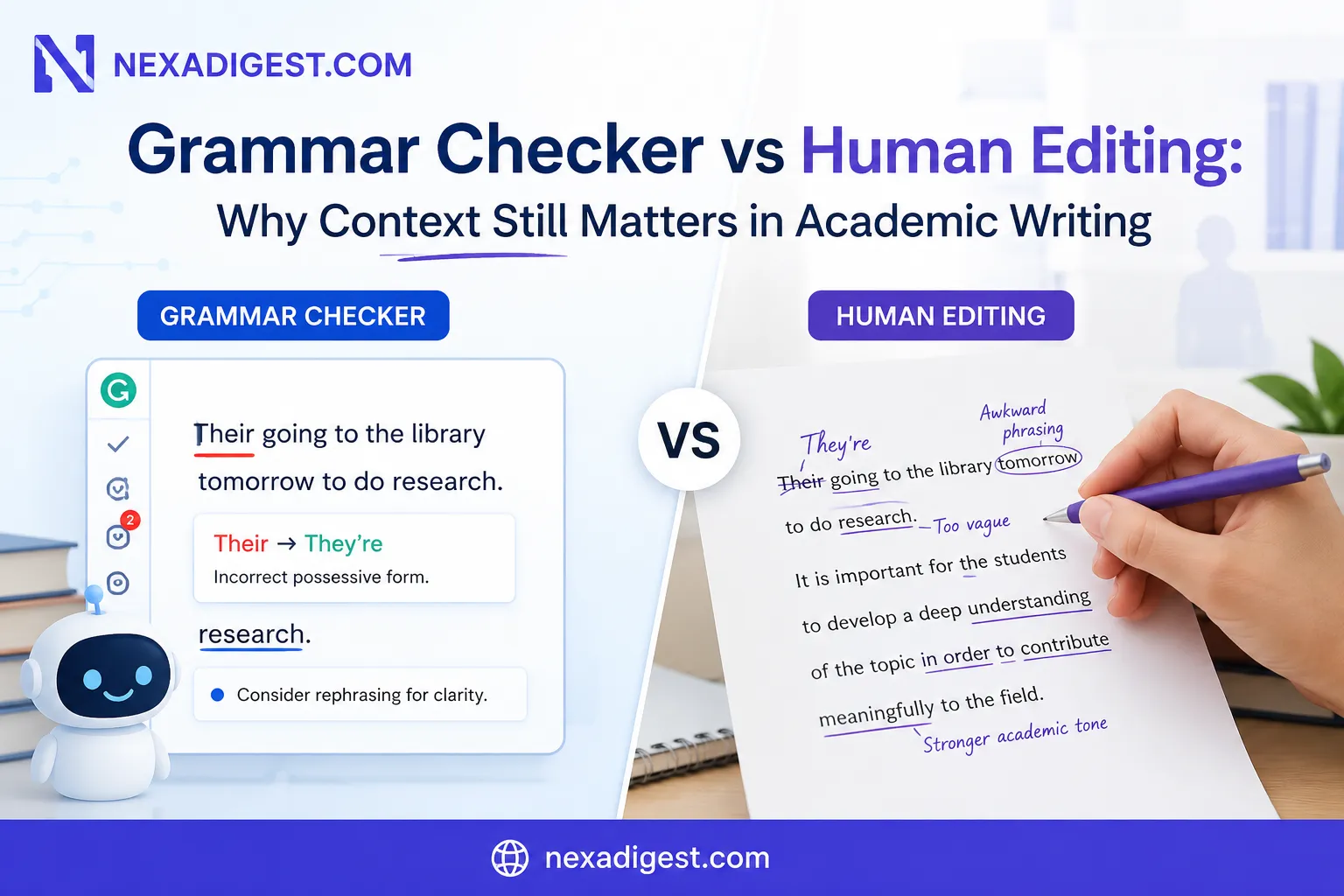
A grammar checker can fix a missing comma in half a second. It can catch a misspelled word before you even notice. But can it tell you that your argument doesn’t make sense, or that your tone feels wrong for an academic paper? This is the real question behind the grammar checker vs human editing debate.
Millions of students and writers now rely on tools like Grammarly, ProWritingAid, and built-in editors in Word and Google Docs. These tools are fast, convenient, and genuinely helpful for catching small mistakes. But when it comes to academic writing specifically, the grammar checker vs human editing comparison reveals some serious gaps that many students don’t realize until it’s too late.
This article breaks down exactly what grammar checkers do well, where they consistently fail, and how to combine both approaches for the strongest possible academic writing.
Table of Contents
How Grammar Checkers Actually Work
Before comparing grammar checker vs human editing, it helps to understand what these tools are built to do.
Modern grammar checkers use a mix of rule-based grammar systems and machine learning models trained on large volumes of text. When you type a sentence, the tool scans it against thousands of grammar rules and common error patterns, then flags anything that doesn’t match expected structures.
Advanced tools also use natural language processing to catch issues beyond basic grammar, such as passive voice, wordiness, and some tone suggestions. This is genuinely useful technology, and it has improved writing quality for millions of people worldwide.
But here is the core limitation: grammar checkers analyze text at the sentence level, sometimes the paragraph level. They do not understand your assignment, your professor’s expectations, your argument’s logic, or the broader context of your academic field.
Also Read :: How Do AI Detectors Work? The Science Behind Tools Like GPTZero
What Grammar Checkers Do Well
To keep the grammar checker vs human editing comparison fair, let’s start with where these tools genuinely shine.
- Catching typos and spelling mistakes almost instantly, which saves significant proofreading time.
- Flagging basic grammar errors like subject-verb agreement, incorrect verb tenses, and misplaced commas.
- Suggesting stronger word choices for repetitive or weak vocabulary.
- Identifying passive voice and offering active voice alternatives.
- Checking punctuation consistency across long documents.
- Providing instant feedback without waiting for a human reviewer, which is valuable during late-night writing sessions before a deadline.
For a first draft, especially for non-native English writers, these tools genuinely reduce the number of small errors that would otherwise distract from the actual content.
Where Grammar Checkers Consistently Fail
This is where the grammar checker vs human editing debate gets serious, especially for academic writing.
1. They Don’t Understand Your Argument
A grammar checker can confirm your sentence is grammatically correct while completely missing that the sentence contradicts your thesis statement from three paragraphs earlier. Academic writing depends on logical flow and consistent argumentation, something no current grammar tool can genuinely evaluate.
2. They Miss Field-Specific Context
Academic writing varies significantly by discipline. A sentence considered perfectly appropriate in a literature essay might be too informal for a scientific research paper. Grammar checkers apply generic rules across all writing types, without understanding that your biology lab report needs a different tone than your English literature analysis.
3. They Struggle With Nuanced Tone
Academic writing often requires a specific tone: formal, objective, and precise. Grammar checkers frequently suggest changes that make writing sound more casual or conversational, following general “readability” trends built for blog content and marketing copy, not scholarly work.
4. They Can Flag Correct Technical or Specialized Language
Field-specific terminology, citations, and technical phrases often get flagged as errors simply because they don’t match the tool’s general training data. A chemistry student citing a compound name or a law student using proper legal terminology might see unnecessary red flags throughout their document.
5. They Cannot Verify Facts or Citations
A grammar checker vs human editing comparison must include this critical gap: no grammar tool can confirm whether your citation format matches your required style guide correctly, whether your facts are accurate, or whether your sources actually support your claims.
6. They Don’t Understand Assignment Requirements
Your professor might require a specific structure, word count, or argument style that has nothing to do with grammar. A grammar checker has no awareness of your assignment rubric, so it cannot tell you if you’ve actually answered the question being asked.
Real Examples: Where the Gap Shows Up
Consider a student writing a philosophy essay who writes a technically correct but logically weak sentence: “Since some people disagree with utilitarianism, it must be flawed.” A grammar checker sees perfect grammar. A human editor immediately notices the logical fallacy and would flag it as weak reasoning that needs revision.
Or consider a nursing student writing a case study who correctly uses complex medical terminology that a grammar checker doesn’t recognize, causing it to suggest replacing accurate clinical terms with simpler, less precise language. Following this suggestion would actually reduce the academic quality and accuracy of the paper.
These examples highlight the real difference in the grammar checker vs human editing conversation: grammar tools optimize for surface-level correctness, while human editors evaluate meaning, context, and purpose.
Why Human Editing Still Matters in Academic Writing
Human editors, whether that’s a professor, writing center tutor, peer reviewer, or professional editor, bring several things no grammar checker currently replicates:
- Contextual understanding of your specific assignment, course, and academic field.
- Critical evaluation of your argument’s logic, evidence, and overall persuasiveness.
- Awareness of your audience, including what your professor specifically expects from this type of paper.
- Recognition of your personal voice, distinguishing between grammar issues and your natural writing style that shouldn’t be flattened into generic phrasing.
- Ability to verify facts and citations against actual source material and required style guides.
- Feedback on structure and flow at the whole-document level, not just sentence by sentence.
This is exactly why writing centers, academic advisors, and thesis committees remain essential parts of the academic writing process, even in an age of powerful AI writing tools.
The Best Approach: Using Both Together
The smartest students don’t choose one side of the grammar checker vs human editing debate. They use both strategically, at the right stage of the writing process.
Step 1: Draft freely.
Write your first draft without worrying too much about small grammar issues. Focus on getting your ideas and argument structure down first.
Step 2: Run a grammar checker.
Use a tool like Grammarly or ProWritingAid to catch obvious errors, typos, and basic grammar issues. This saves time and lets your human editor focus on bigger issues instead of comma placement.
Step 3: Review flagged suggestions critically.
Don’t accept every suggestion automatically. Ask yourself if the flagged phrase is actually wrong, or if it’s simply different from the tool’s generic preference.
Step 4: Get human feedback.
Share your draft with a professor, writing center tutor, or peer reviewer who understands your specific assignment and academic field. Ask them to focus on argument, structure, and content accuracy.
Step 5: Do a final grammar pass.
After incorporating human feedback and making structural changes, run your grammar checker one more time to catch any new errors introduced during revision.
This combined workflow uses each tool for what it does best: grammar checkers for speed and consistency, human editors for judgment and context.
Choosing the Right Grammar Checker for Academic Work
If you decide to use a grammar checker as part of your process, some tools work better for academic writing than others:
- Grammarly Premium offers tone detection and clarity suggestions, though its formality settings need manual adjustment for academic work.
- ProWritingAid provides deeper style reports, including overused words and sentence length variation, useful for longer academic papers.
- Hemingway Editor focuses on readability and sentence complexity, though it can sometimes push academic writing toward oversimplification.
- Built-in Word and Google Docs checkers offer basic grammar support but lack the deeper style analysis of dedicated tools.
Whichever tool you choose, remember it should support your writing process, not replace the judgment that only comes from careful human review.
The Impact on Non-Native English Writers
The grammar checker vs human editing question becomes especially important for non-native English speakers writing academic papers. Grammar tools genuinely help this group catch common structural errors, article usage mistakes, and preposition issues that are easy to overlook.
However, these students face a unique risk: grammar checkers sometimes flag naturally correct sentence structures simply because they differ from the most statistically common pattern in the tool’s training data. A student might write a perfectly correct sentence using formal academic phrasing common in their home country’s education system, only to have it flagged as “unnatural” by a tool trained mostly on American or British writing conventions.
This is where human editors, especially writing center tutors experienced with multilingual students, provide something irreplaceable. They can distinguish between an actual grammar error and a stylistic difference that doesn’t need correcting at all. Relying only on a grammar checker in this situation risks stripping away a student’s natural voice in favor of an artificially “standardized” version of English.
How Professors and Institutions View Grammar Checker Use
Many universities now have explicit policies about grammar checker use, separate from their AI writing policies. Most institutions consider basic grammar and spell-check tools acceptable, similar to how a dictionary or thesaurus has always been allowed.
However, some professors express concern when grammar checkers are used to substantially rewrite sentences rather than simply flag errors. The distinction usually comes down to this: catching an error and fixing it yourself is standard practice, but accepting an AI-generated rewrite of an entire sentence or paragraph without understanding the change starts to blur the line between editing and outsourcing the actual thinking.
Students should always check their specific course or institution’s policy, since acceptable grammar checker use can vary between departments, especially in writing-intensive courses where developing your own voice is part of the learning objective.
A Quick Comparison: Grammar Checker vs Human Editing
| Feature | Grammar Checker | Human Editor |
|---|---|---|
| Speed | Instant | Takes time to schedule and review |
| Cost | Often free or low-cost subscription | Can be free (writing centers) or paid |
| Catches typos and basic grammar | Excellent | Good, but slower |
| Understands assignment context | No | Yes |
| Evaluates argument logic | No | Yes |
| Adapts to academic discipline | Limited | Yes |
| Preserves personal writing voice | Inconsistent | Yes, when done well |
| Verifies citations and facts | No | Yes |
| Available 24/7 | Yes | Usually limited by availability |
This comparison makes the grammar checker vs human editing relationship clear: the two serve genuinely different purposes, and neither one fully replaces the other for serious academic work.
Building a Personal Editing Habit That Actually Works
Beyond just combining tools, developing strong personal editing habits makes a real long-term difference in academic writing quality.
- Read your writing out loud. This simple habit catches awkward phrasing and unclear sentences that both grammar checkers and quick human skims sometimes miss.
- Take a break before final review. Stepping away from your draft for even a few hours helps you spot errors and logic gaps with fresh eyes.
- Keep a personal error log. Track the specific mistakes grammar checkers or professors repeatedly flag in your writing, so you can address the root habit instead of just fixing surface symptoms each time.
- Ask “why,” not just “what.” When a grammar checker or human editor suggests a change, understand the reasoning behind it, so your writing genuinely improves over time instead of just getting corrected in the moment.
Frequently Asked Questions
Can a grammar checker replace a human editor for academic writing?
No. Grammar checkers handle surface-level errors well but cannot evaluate argument quality, logical flow, or assignment-specific requirements the way a human editor can.
Should I trust every suggestion a grammar checker makes?
No. Review suggestions critically, especially for technical terminology, field-specific language, and your intended tone, since generic tools sometimes push writing toward overly casual phrasing.
Is it fine to rely only on a grammar checker if I don’t have access to a human editor?
A grammar checker is far better than no review at all, but seek out free resources like university writing centers, peer review groups, or professor office hours whenever possible for deeper feedback.
Do grammar checkers understand different academic disciplines?
Not well. Most grammar checkers apply general writing rules across all content types, without adjusting for the specific tone and terminology expectations of different academic fields.
Final Thoughts
The grammar checker vs human editing debate isn’t really about choosing a winner. It’s about understanding what each approach actually offers, and using them together intelligently. Grammar checkers save time and catch errors that are easy to miss during late-night writing sessions. Human editors bring context, judgment, and a genuine understanding of what your writing needs to accomplish.
For strong academic writing, the best students treat grammar checkers as a helpful first pass, not a final authority. Real growth as a writer still comes from thoughtful human feedback, careful revision, and understanding the “why” behind every suggestion, whether it comes from a tool or a trusted mentor.