How Do Plagiarism Checkers Work? A Complete Guide for Students and Writers
Every semester, thousands of students submit essays and worry about the same question: will my plagiarism checker flag something I didn’t even copy on purpose? Understanding how plagiarism checkers work removes a lot of that anxiety and helps you write with confidence instead of fear.
Tools like Turnitin, Copyscape, and Grammarly’s plagiarism checker have become standard parts of academic life. But most students never learn what actually happens when they hit submit. This article explains, in plain language, how plagiarism checkers work, what they can and cannot detect, and how to avoid accidental flags.
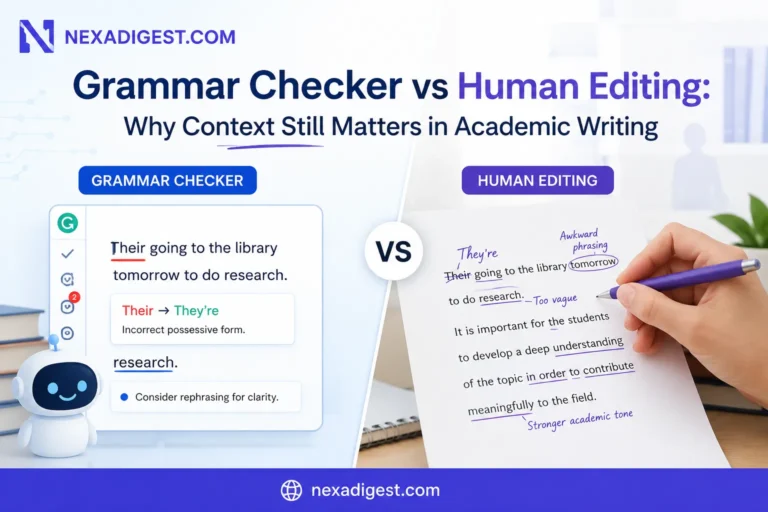
Also Read :: Grammar Checker vs Human Editing: Why Context Still Matters in Academic Writing
Table of Contents
What Is a Plagiarism Checker?
A plagiarism checker is a tool that scans a document and compares it against a massive database of existing content to find matching or highly similar text. The goal is to identify passages that appear to be copied from another source without proper citation.
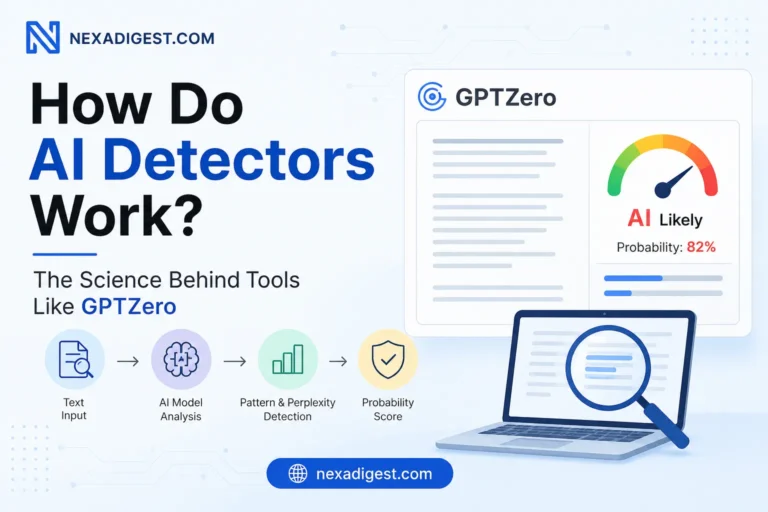
Unlike an AI detector, which predicts whether text was AI-generated, a plagiarism checker focuses purely on originality. It answers a different question entirely: has this exact wording, or something very close to it, already been published somewhere else?
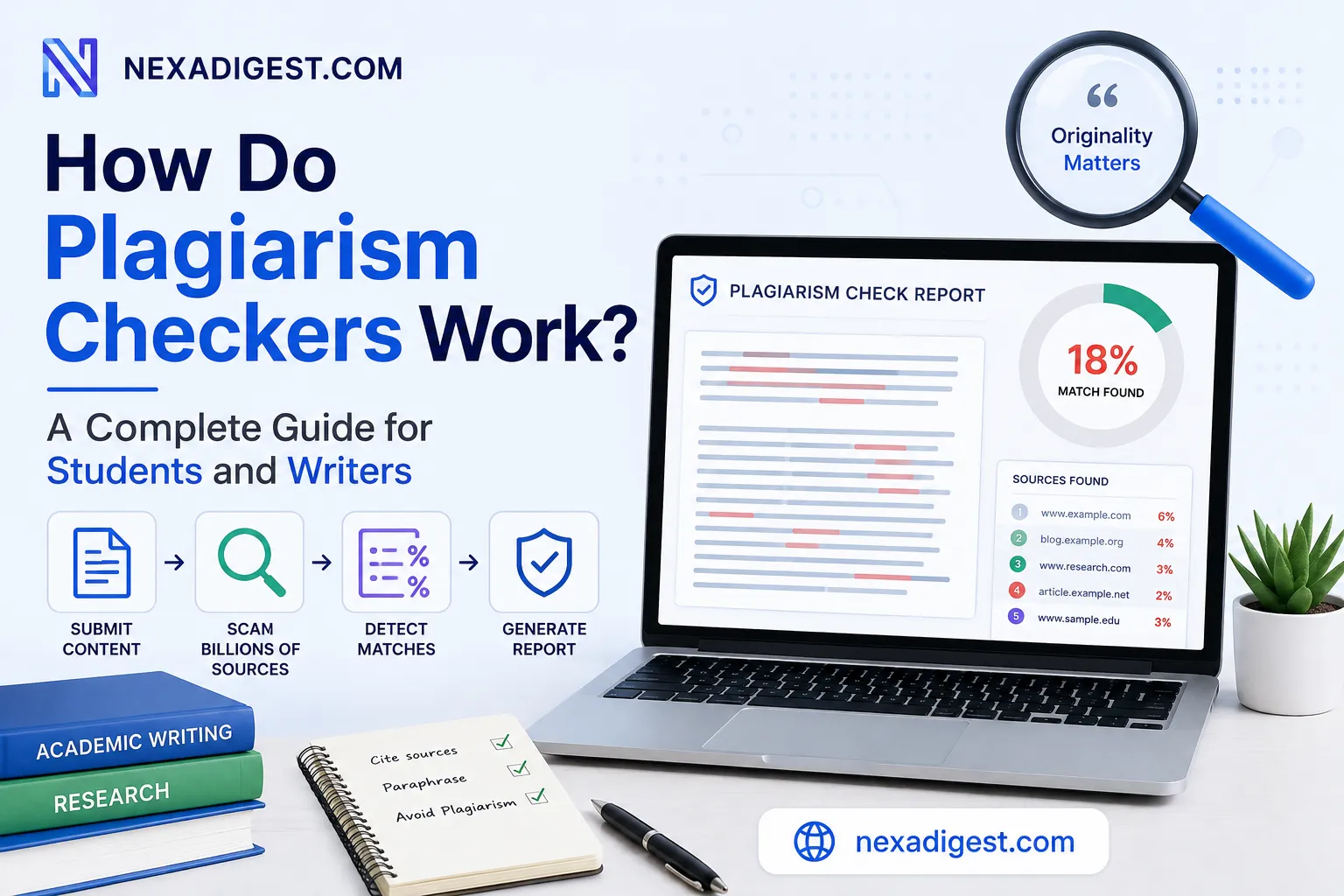
The Core Process: How Plagiarism Checkers Work Step by Step
Here’s a breakdown of the actual technical process behind the scan.
- Document Upload:
- You submit your paper through the platform, whether that’s Turnitin integrated into your university’s learning system or a standalone tool.
- Text Extraction:
- The tool extracts the raw text from your document, removing formatting, images, and other non-text elements.
- Segmentation:
- Your writing gets broken into smaller chunks, often overlapping phrases of several words each, so the tool can compare small sections rather than just whole paragraphs.
- Database Comparison:
- Each segment is compared against the tool’s database, which typically includes billions of web pages, academic journals, published books, and previously submitted student papers.
- Similarity Scoring:
- The tool calculates a percentage score representing how much of your document matches existing sources.
- Report Generation:
- A detailed report highlights matched sections, links them to their original sources, and shows your overall similarity percentage.
This entire process, similar to how AI detectors work, relies on pattern matching technology, but plagiarism checkers focus on exact or near-exact text matches rather than statistical writing style.
What Databases Do Plagiarism Checkers Search?
The strength of any plagiarism checker depends heavily on the size and scope of its database. Most major tools search across:
- Published academic journals and research papers, often through partnerships with academic publishers.
- Public websites and online articles, crawled similarly to how search engines index the web.
- Books and published literature, particularly for tools with publisher partnerships.
- Previously submitted student papers, especially for Turnitin, which builds a growing internal database from every university using the platform.
- News articles and journalism archives, useful for catching content copied from media sources.
This matters a lot for students: your paper isn’t just compared against the internet, it’s often compared against millions of other student papers submitted through the same system over the years.
Types of Plagiarism These Tools Catch
Not all plagiarism looks the same, and these detection systems are built to catch several distinct categories.
Direct copying involves pasting text word-for-word from a source without citation. This is the easiest type for any tool to catch, since it produces an exact text match.
Mosaic plagiarism happens when a writer mixes copied phrases with their own words, creating a patchwork of borrowed and original content. Modern plagiarism checkers are specifically designed to catch this pattern by comparing smaller text segments rather than whole sentences.
Paraphrased plagiarism occurs when someone rewords a source closely enough that the structure and ideas remain nearly identical, even though individual words change. This is harder for plagiarism checkers to catch consistently, since it requires semantic understanding rather than simple text matching.
Self-plagiarism involves reusing your own previously submitted work without permission or citation. Many students don’t realize this counts as a violation, but Turnitin’s growing database of student submissions makes this increasingly easy to detect.
Why Plagiarism Checkers Sometimes Flag Innocent Writing
A common source of stress is discovering a high similarity score on original work. Here’s why this happens.
- Common phrases and standard terminology in technical or scientific fields often match other papers simply because there are limited ways to describe certain concepts accurately.
- Properly cited quotes still get flagged as matches, since the tool is detecting text similarity, not evaluating whether you cited it correctly.
- Bibliography and reference sections frequently trigger high match percentages because citation formatting is naturally similar across papers using the same sources.
- Common introductory phrases, like standard essay openings taught in writing classes, can match thousands of other student papers using similar structures.
This is exactly why a raw similarity percentage should never be read as an automatic guilt indicator. A responsible instructor reviews the actual highlighted matches, not just the final number.
Plagiarism Checker vs AI Detector: What’s the Difference?
Students often confuse these two tools, but the underlying mechanics reveal a clear distinction. This kind of tool asks: “Does this text match something already published?” An AI detector asks: “Does this text show statistical patterns common in AI-generated writing?”
It’s entirely possible for a paper to pass a plagiarism check with a low similarity score while still being flagged by an AI detector, since AI-generated text is often original in wording but predictable in structure. Understanding both tools separately helps students and educators interpret each result correctly, rather than assuming a clean plagiarism report means a paper is fully original human work.
How to Avoid Accidental Plagiarism Flags
This knowledge gives you practical ways to protect your original writing from unnecessary flags.
- Cite properly using your required style guide, whether that’s APA, MLA, or Chicago, so quoted material is clearly marked rather than blending into your own text.
- Paraphrase genuinely, changing sentence structure and word choice rather than just swapping a few synonyms, which still triggers similarity matches.
- Keep your own notes organized separately from source material, so you don’t accidentally copy phrasing while taking notes and later forget it wasn’t originally your own wording.
- Run a check yourself before submitting, using the same tool your institution uses if possible, so you can review flagged sections and fix genuine issues before your professor sees them.
- Understand your institution’s threshold, since most universities don’t expect a 0 percent score, given that citations and common phrases naturally create some matches.
The Technology Behind Text Matching
At the technical level, most plagiarism detection systems rely on a method called string matching combined with fingerprinting. The software converts chunks of your text into unique digital fingerprints, then compares those fingerprints against a massive index of previously fingerprinted content. This approach is far faster than comparing raw text word by word, allowing a full document scan to complete within minutes.
Some newer systems also apply semantic similarity models, which go beyond exact word matching to catch content that expresses the same idea using different vocabulary. This is a meaningful evolution, since early-generation tools relied almost entirely on exact phrase matching and missed many cases of light paraphrasing. Even with these improvements, no current system fully understands meaning the way a human reader does, which is why manual review still matters for borderline cases.
Turnitin’s Growing Database Problem
Turnitin deserves special attention since it dominates the education sector. Every time a student submits a paper through Turnitin at a participating institution, that paper often becomes part of the internal comparison database for future submissions. Over more than two decades, this has created one of the largest academic writing repositories in the world.
This creates an interesting effect: a student’s own essay from freshman year could theoretically trigger a match years later if they reuse similar phrasing in a graduate thesis, which falls under the self-plagiarism category discussed earlier. Universities handle this differently, so students working on related topics across multiple courses or degree levels should ask their institution directly about self-citation policies.
Industries Beyond Education Using Similarity Detection
While students encounter these tools most often, similarity detection extends well beyond academic settings. Publishers use tools like Copyscape to protect original journalism and blog content from being copied without permission. Content marketing agencies run similarity checks before publishing client work to avoid duplicate content penalties in search rankings. Legal teams sometimes use specialized software to detect copied language in contracts or filed documents.
Understanding this broader context helps explain why these detection systems have become so sophisticated. The underlying technology serves publishers, universities, and businesses simultaneously, which has driven continuous investment in better matching algorithms across the industry.
Building Better Research and Writing Habits
Beyond simply avoiding a bad similarity score, developing strong research habits protects your academic integrity in the long run. Keep a clear separation between direct quotes, paraphrased ideas, and your own original analysis while drafting, ideally using different formatting or color coding in your notes so nothing gets confused later.
When paraphrasing, try closing the source material entirely and writing the idea from memory in your own words, then check back afterward to verify accuracy. This produces genuinely original phrasing rather than a lightly edited version of the source sentence structure, which similarity software is specifically designed to catch.
Frequently Asked Questions
What percentage similarity score counts as plagiarism?
qThere’s no universal number. Most institutions consider context more important than the raw percentage, since properly cited material still shows up as a match.
Can these tools detect paraphrased content?
Somewhat. Modern tools are improving at catching closely paraphrased text, but heavily reworded content with genuinely different sentence structure is harder to detect than direct copying.
Do plagiarism checkers store my paper permanently?
This depends on the tool. Turnitin, for example, often adds submitted papers to its comparison database for future checks, which students should be aware of before submitting sensitive or unpublished work.
Is a 0 percent plagiarism score always a good thing?
Not necessarily. An unusually low score on a research-heavy paper with no matches at all can sometimes indicate missing citations rather than perfectly original writing.
What Happens After a Flag: The Human Review Process
Even the most sophisticated similarity software is only the first step. Once a report is generated, a professor or academic integrity committee typically reviews every highlighted match individually, checking whether it represents a genuine citation, a common phrase, or an actual violation.
This human review stage matters because raw percentages alone tell an incomplete story. A paper with a 25 percent similarity score might be entirely legitimate if most matches come from a properly formatted bibliography, while a paper with a 5 percent score could still contain a serious issue if that small percentage represents a single uncited paragraph lifted directly from a source. Responsible institutions train reviewers to look past the number and examine context, which is why students shouldn’t panic over a score alone without seeing which sections were actually flagged.
Final Thoughts
Understanding how plagiarism checkers work turns a stressful, mysterious process into something manageable and predictable. These tools rely on database comparison and text segmentation, not judgment or intent, which means a match doesn’t automatically mean wrongdoing.
The best approach combines proper citation habits, genuine paraphrasing, and checking your own work before submission. Once you understand the process, you can write confidently, knowing exactly what these tools are looking for and how to present your original ideas clearly and honestly. That confidence, more than any single score, is what actually protects your academic integrity over the long run.