Home Workouts for Beginners: No Equipment Needed
Let me guess. You have thought about working out for months, maybe years, but something always gets in the way. The gym is too far. Too expensive. Too full of people who seem to know exactly what they are doing while you are standing there wondering which machine does what.
Here is the thing: you do not need any of that. Home workouts for beginners build real strength just as well, with no commute, no monthly fee, and no waiting for equipment.
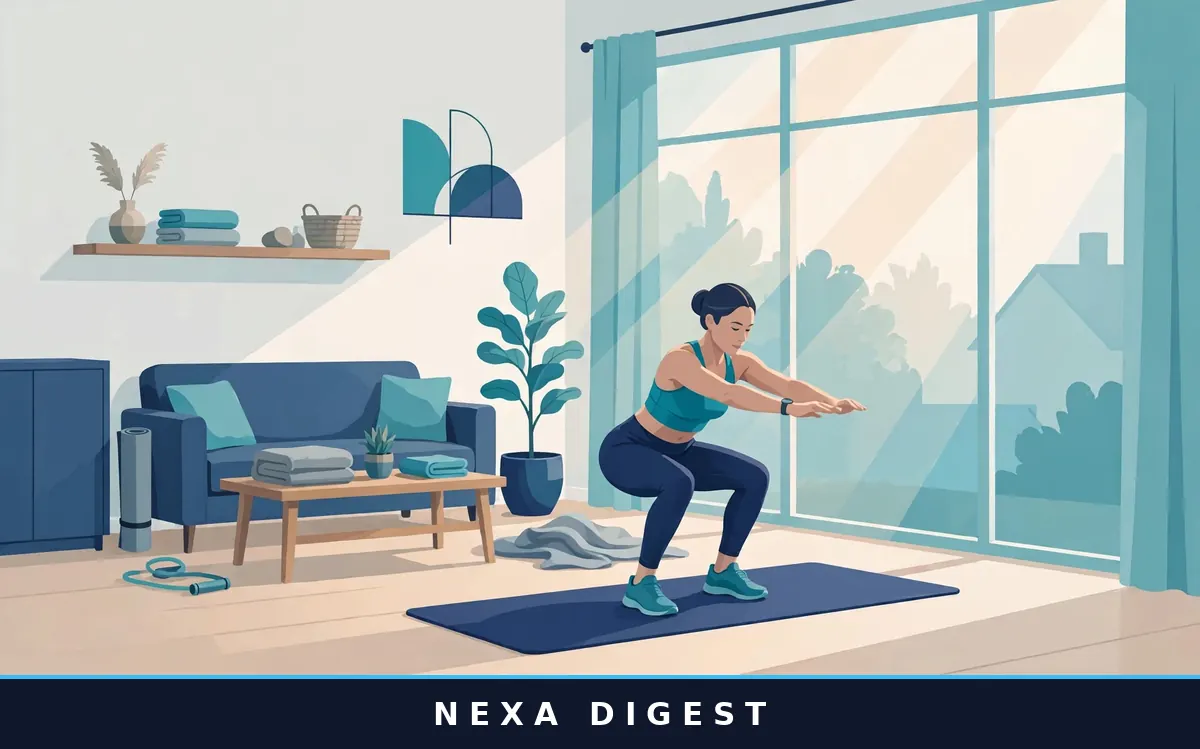
All you need is your bodyweight, a patch of floor, and about half an hour. I am going to walk you through 20 exercises that actually work, a 4-week plan that will not destroy you in week one, the form mistakes almost everyone makes, and what to eat so your effort is not wasted. Let us get into it.
Table of Contents
- Why Home Workouts for Beginners Work So Well
- What You Need to Get Started
- The 5-Minute Warm-Up (Do This Every Time)
- 20 No-Equipment Exercises for Beginners
- Your 4-Week Home Workouts for Beginners Plan
- 7 Form Mistakes Beginners Make (And How to Fix Them)
- What to Eat to Support Your Training
- Track Your Progress and Stay Consistent
- FAQs
Why Home Workouts for Beginners Work So Well
Some people think bodyweight training does not count unless iron is involved. That is nonsense. Your body cannot tell the difference between a dumbbell and gravity. Resistance is resistance, and studies confirm bodyweight movements build genuine strength when you progress them over time.
And starting at home? It has some real advantages the gym crowd does not talk about:
- It costs nothing. No membership, no gear. The biggest reason people quit the gym just disappeared.
- Nobody is watching. Wobble through your first lunges in total privacy. No mirrors, no judgment.
- It fits your life. Twenty-five minutes before work, at lunch, whenever. No two-hour gym ordeal.
- Your joints will thank you. You learn the movements with your own bodyweight first, which is way more forgiving than loading up a barbell on day one.
- It actually works your whole body. Moves like squats, push-ups, and planks hit multiple muscle groups at once. Efficient is an understatement.
Health guidelines say adults need at least 150 minutes of moderate activity per week plus muscle-strengthening on two or more days. Three short home sessions cover the strength part. A few brisk walks on your off days handle the cardio. Done.
What You Need to Get Started
Spoiler: almost nothing. But let us be specific so you are not hunting for stuff mid-workout:
- Floor space about 2 by 2 meters. Enough to lie down with your arms out. Move the coffee table.
- Clothes you can move in and decent shoes, or just bare feet on a mat if that feels better.
- Water nearby. You will want it. Trust me.
- Nice to have: an exercise mat (your knees will appreciate it) and a sturdy chair for dips. Not a wobbly one. Test it first.
That is genuinely it. If anyone tries to sell you a $300 “home gym starter kit” for bodyweight training, walk away.
The 5-Minute Warm-Up (Do This Every Time)
Warming up is boring, but skipping it is how you pull something in week two and quit by week three. Five minutes. Non-negotiable.
Do each of these for 45 to 60 seconds before every session:
- March in place. Knees up to hip height, arms swinging like you mean it.
- Arm circles. Twenty seconds forward, twenty backward. Start small, get bigger.
- Hip circles. Hands on hips, ten slow rotations each way. Your hips hold more tension than you think.
- Shallow squats. Half-depth only. You are waking up your knees and hips, not testing them.
- Cat-cow stretches. On all fours, alternate between arching your back up and letting it sag down. Feels amazing.
You should feel a little warm and be breathing slightly faster. That is your green light.
20 No-Equipment Exercises for Beginners
Here are 20 exercises organized by muscle group. Each has form cues, a rep target, and an easier version. No shame in the easy version — it is how you reach the hard one.
Start with 2 sets of each, resting 30 to 60 seconds between sets.
Lower Body
1. Bodyweight Squats. Feet shoulder-width apart, toes slightly out. Push hips back like sitting into a chair, chest up, knees tracking over toes. Lower until thighs are parallel, drive through heels to stand. 2 x 10-15. Hits: quads, glutes, core. Easier: tap a chair behind you.
2. Reverse Lunges. Step one foot back, lower until both knees hit 90 degrees. Torso upright, front knee behind toes. Push through the front heel to stand. 2 x 8-10 per leg. Hits: quads, glutes, balance. Easier: hold a wall.
3. Glute Bridges. On your back, knees bent, feet flat. Press through heels, lift hips until shoulders-to-knees form a straight line. Squeeze glutes one second at top, lower slowly. 2 x 12-15. Hits: glutes, hamstrings, lower back.
4. Calf Raises. Feet hip-width apart, rise onto balls of feet, pause, lower slowly. 2 x 15-20. Hits: calves, ankles.
5. Wall Sit. Back flat on wall, slide down until thighs are parallel, knees over ankles. Hold and breathe. 20-30 sec x 2. Hits: quads, glutes. Easier: half-depth.
6. Sumo Squats. Wide stance, toes out 45 degrees. Lower hips straight down, chest upright. 2 x 10-12. Hits: inner thighs, glutes, quads.
Upper Body
7. Wall Push-Ups. Arm’s length from wall, palms flat at shoulder height. Bend elbows, bring chest to wall, push back. 2 x 12-15. Hits: chest, shoulders, triceps.
8. Knee Push-Ups. From knees, hands wider than shoulders, body straight head-to-knees. Lower chest, elbows at 45 degrees, push up. 2 x 6-10. At 12 clean reps, try full push-ups.
9. Incline Push-Ups. Hands on a sturdy counter or couch arm, feet back in plank. Lower chest, push up. 2 x 8-12. Hits: chest, shoulders, triceps.
10. Chair Tricep Dips. Grip a sturdy chair edge, slide hips off, lower by bending elbows to 90 degrees. Press back up. 2 x 8-10. Hits: triceps, shoulders. Easier: knees bent.
11. Superman Pull. Face down, arms overhead. Lift arms, chest, and legs together, squeezing shoulder blades. Hold one second, lower. 2 x 10-12. Hits: back, glutes, shoulders.
12. Pike Push-Ups. Downward-dog shape, hips high. Bend elbows, lower head toward floor, push up. 2 x 6-8. Hits: shoulders, triceps.
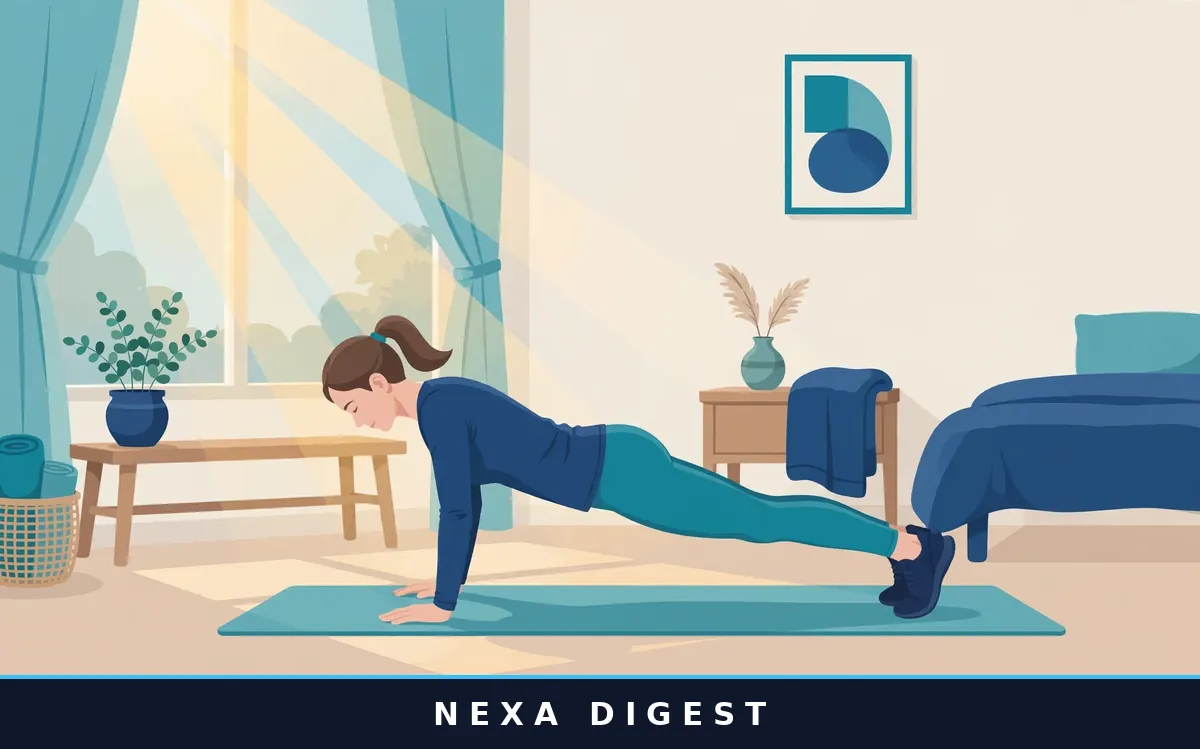
13. Plank Shoulder Taps. High plank, tap one hand to opposite shoulder without rocking hips. Go slow. 2 x 8 per side. Hits: shoulders, core.
Core
14. Plank. Forearms and toes (or knees), elbows under shoulders, body straight head-to-heels. Squeeze glutes, brace abs, no sagging hips. 20-30 sec x 2. Build to 60.
15. Dead Bug. On your back, arms up, knees at 90 degrees over hips. Lower right arm overhead while extending left leg, lower back pressed down. Switch. 2 x 8 per side. Hits: deep core.
16. Bicycle Crunches. Hands behind head, bring right elbow to left knee while extending right leg. Alternate smoothly. 2 x 10 per side. Hits: obliques, abs.
17. Mountain Climbers. High plank, drive knees to chest alternating quickly. Hips level, core tight. 20-30 sec x 2. Easier: slow stepping.
18. Side Plank (Knees). On your side, forearm down, knees stacked. Lift hips into a straight line knees-to-head. 15-20 sec per side x 2.
19. Reverse Crunches. On your back, knees at 90 degrees. Curl hips off floor, knees to chest, lower with control. 2 x 10-12. Hits: lower abs.
20. Bird Dog. On all fours, extend right arm and left leg together. Hold two seconds, torso still. Switch. 2 x 8 per side. Hits: core, back, balance.
Your 4-Week Home Workouts for Beginners Plan
Three training days a week, always with a rest day between. Muscles get stronger during recovery, not during the workout. Each week, do a little more: extra reps, longer holds, or another set. That gradual increase is called progressive overload.
Squats, reverse lunges, glute bridges, calf raises, plank, dead bug
2 sets of each
20-minute walk plus gentle stretching
Keep it light
Knee push-ups, incline push-ups, chair dips, Superman pull, side plank, bird dog
2 sets of each
Seriously. Rest. Your muscles are rebuilding.
No workout
Sumo squats, wall push-ups, mountain climbers, bicycle crunches, wall sit, reverse crunches
2 rounds, 30 seconds rest between exercises
20-minute walk plus gentle stretching
Keep it light
You earned it.
No workout
- Week 1: Learn the movements. Use easier variations. Two sets, generous rest.
- Week 2: Add 2-3 reps or 5-10 seconds per hold.
- Week 3: Add a third set to two exercises. Rest 30 seconds between sets.
- Week 4: Three sets on most exercises. Try one unmodified move.
After week four, repeat with harder variations. Stop any exercise that causes sharp pain immediately.
7 Form Mistakes Beginners Make (And How to Fix Them)
Bad form — not laziness — is why most beginner routines fail. These seven mistakes cover nearly everything that goes wrong:
- Holding your breath. Breathe out on the effort, in on the return.
- Sagging hips in planks. Squeeze glutes, keep your body in one straight line.
- Knees caving in on squats. Push knees outward, tracking over toes.
- Elbows flared on push-ups. Tuck to about 45 degrees from your torso.
- Rushing reps. Slow down: two seconds down, one-second pause, then lift.
- Skipping the warm-up. Five minutes, every time. No exceptions.
- Too much, too soon. Still sore after four days? Scale back.
What to Eat to Support Your Training
Training is half the equation. Nail these nutrition basics and your results multiply:
- Get enough protein. A palm-sized portion at each meal — eggs, chicken, fish, lentils, yogurt, tofu.
- Eat before training. A banana or toast with peanut butter 1-2 hours beforehand.
- Hydrate. Water before, during, and after training.
- Prioritize whole foods. Vegetables, fruits, whole grains, lean proteins for steadier energy.
Want a deeper dive into eating well from scratch? Check out our Balanced Diet for Beginners guide.
Track Your Progress and Stay Consistent
Motivation fades. Systems stick. Two that work:
- Log every session. Exercises, sets, reps. Watching your numbers climb is powerful motivation. See the best Android apps for digital options.
- Stack it on an existing habit. Train right after morning coffee or before your evening shower. Our daily habits guide explains why this works.
Three decent home workouts for beginners weekly beats one heroic workout followed by six days off. Consistency wins.
FAQs
How often should I do home workouts for beginners routines each week?
Three full-body sessions is the sweet spot, with at least one rest day between strength days. Your muscles need 24 to 48 hours to recover and actually get stronger. Light walks on rest days are great.
Can I really build muscle with just bodyweight exercises?
Yes, genuinely. Research shows bodyweight training builds strength and muscle effectively, especially in your first 6 to 12 months. The key is progressive overload — gradually doing more reps, more sets, or harder variations over time. Your muscles do not know you are not at a gym.
How long should a beginner home workout last?
Twenty to 40 minutes including the warm-up is plenty. I would take 30 focused minutes over a distracted hour any day. Quality of each rep matters more than total time.
Do I really need to warm up before home workouts for beginners?
Every single time. Five minutes of light movement raises your body temperature, gets your joints ready, and meaningfully lowers your injury risk. Skipping it to save five minutes is a terrible trade.
What if I cannot do a single push-up?
Then you start with wall push-ups, exactly like this guide says. Then incline, then knees, then full. Most people get to full push-ups within 4 to 8 weeks if they stay consistent. The progression IS the program. Nobody starts at the finish line.
Should I be sore after every workout?
Some soreness in the first couple of weeks is totally normal — your body is adapting to something new. But soreness is not the goal and it is not required. If your reps are going up and you feel stronger, the program is working, sore or not.
When should I add equipment or join a gym?
When your bodyweight progress genuinely stalls for several weeks despite consistent training. For most people that is somewhere around 3 to 6 months in. Resistance bands are the cheapest, smartest next step before you even think about a gym membership.
Conclusion
You do not need a gym, expensive gear, or experience to get fit. Home workouts for beginners build real strength with nothing but your bodyweight and a corner of your home.
Start with the warm-up, work through the exercises at your pace, and follow the 4-week plan one session at a time. Form beats speed. Rest days count. Showing up consistently matters more than any single workout.
Three sessions a week is all it takes to feel different in a month. The hardest rep is the first one.
Health disclaimer: This article is for general informational purposes only and is not medical advice. Consult a qualified healthcare professional before starting any new exercise program, especially if you have a medical condition, injury, or are pregnant.