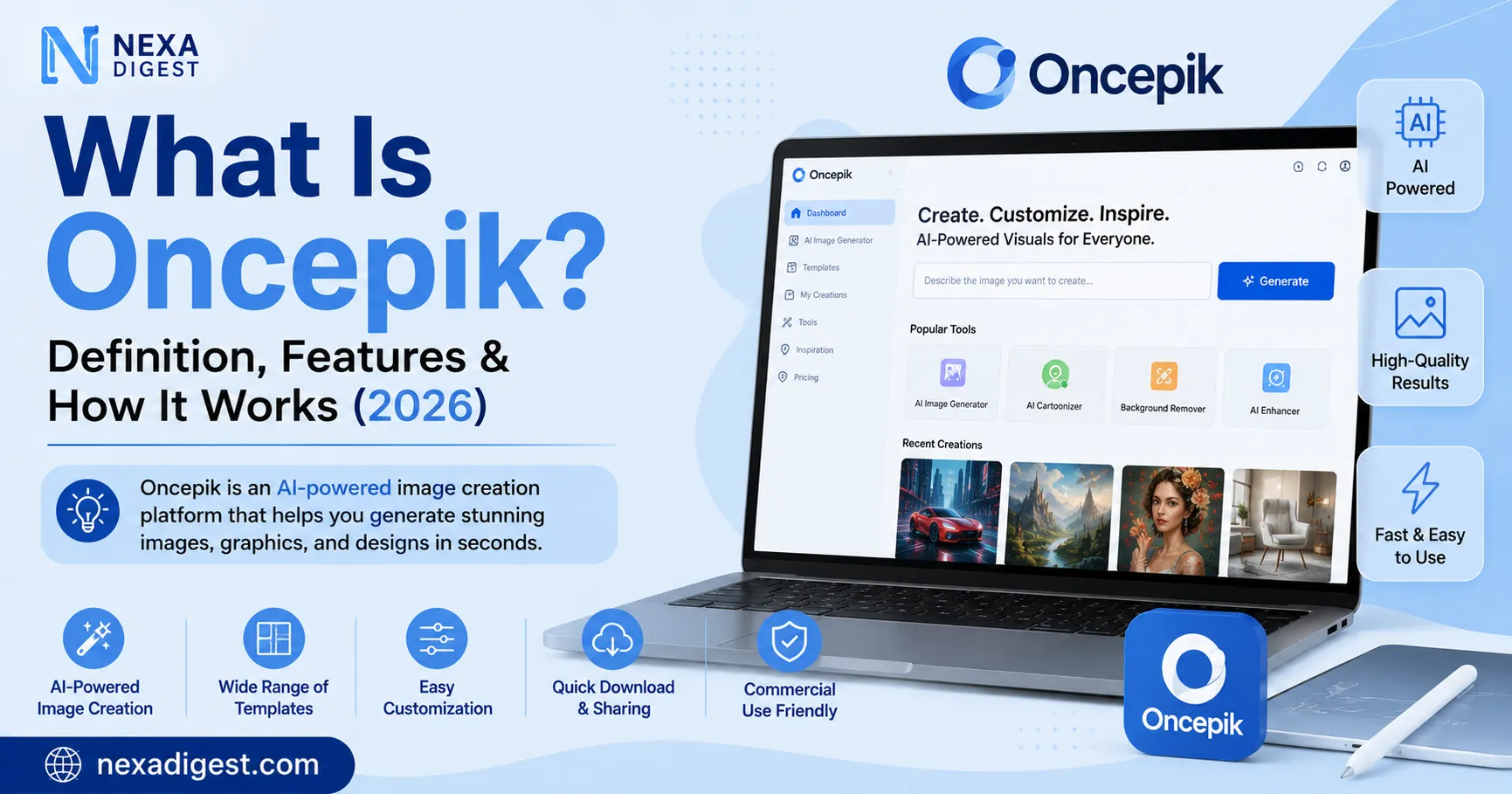
Oncepik is an AI-powered visual productivity and content management platform designed to help bloggers, content creators, marketers, and teams plan, create, organize, and collaborate on projects from a single workspace. It combines AI writing assistance, visual project boards, content planning, workflow management, and real-time collaboration, reducing the need to switch between multiple productivity tools.
If you’re wondering what Oncepik is, how Oncepik works, or whether it’s the right platform for your workflow, this guide explains the Oncepik meaning, its core features, pricing, use cases, AI capabilities, collaboration tools, and how it compares with popular alternatives like Notion and ClickUp.
Oncepik at a Glance
| Feature | Details |
|---|---|
| Platform Type | AI-powered productivity and content management workspace |
| Best For | Bloggers, content creators, marketers, freelancers, startups, and remote teams |
| Core Functions | Content planning, AI writing, project management, collaboration, workflow organization |
| Key Features | Visual workspaces, AI assistance, task management, content workflows, real-time collaboration |
| Supported Use Cases | SEO planning, content calendars, brainstorming, documentation, team collaboration |
| Popular Alternatives | Notion, ClickUp, Trello, Asana |
Quick Answer
- Definition: Oncepik is an AI-powered visual workspace for content creation and project management.
- Primary Purpose: Organize ideas, manage workflows, and collaborate with teams in one platform.
- Target Users: Bloggers, creators, marketers, agencies, and businesses.
- Core Features: AI writing, visual project boards, task management, collaboration, and workflow planning.
- Alternatives: Notion, ClickUp, Trello, and Asana.
Table of Contents
Oncepik Meaning: A Quick Definition
The name reflects the product’s positioning: a single destination covering every stage of content work, from first idea to published post. In practice, that means three layers working as one connected system instead of separate tools bolted together — an AI layer that handles drafting and structure, a visual layer that handles planning and organization, and a collaboration layer that handles team communication.
What separates Oncepik from a general-purpose tool is scope. It isn’t trying to manage every type of business workflow, hiring, finance, operations, and so on. It stays narrowly focused on the content lifecycle specifically, which is why its AI features are tuned toward writing and content structure rather than broader task automation.
Also Read :: How Do Plagiarism Checkers Work? A Complete Guide for Students and Writers
Why a Tool Like Oncepik Exists
Oncepik exists to solve a common productivity problem: managing content creation across multiple disconnected tools. Instead of switching between note-taking apps, AI writing assistants, project management software, cloud storage, and content calendars, Oncepik brings every stage of the content workflow into a single AI-powered productivity workspace.
Traditional content creation often requires separate applications for brainstorming, drafting, editing, task management, file sharing, and team collaboration. While each tool serves a specific purpose, constantly moving between platforms can slow productivity, create communication gaps, duplicate work, and make it difficult to keep projects organized.
Oncepik addresses these challenges by combining AI writing, visual project management, workflow organization, document collaboration, and content planning into one centralized platform. This unified approach helps bloggers, content creators, marketers, agencies, and remote teams manage projects more efficiently while reducing unnecessary context switching and improving collaboration.
Key Benefits of Oncepik
- Centralized Workspace: Manage ideas, documents, tasks, and projects from one platform.
- AI Writing Assistance: Generate, edit, and refine content without leaving your workspace.
- Visual Project Boards: Organize workflows with intuitive drag-and-drop project management.
- Real-Time Collaboration: Work with team members on documents, tasks, and projects simultaneously.
- Content Planning: Build editorial calendars, organize campaigns, and monitor project progress.
- Improved Productivity: Reduce time lost switching between multiple productivity and collaboration tools.
Why It Matters
Whether you’re an individual creator or part of a growing marketing team, Oncepik streamlines the entire content lifecycle—from idea generation and planning to writing, collaboration, publishing, and ongoing content management. By integrating multiple productivity functions into a single workspace, it enables faster workflows, better team communication, and more efficient content operations.
Oncepik Features
Oncepik’s feature set is built around a few core pillars that work together rather than functioning as separate, disconnected tools.
AI Outline and Draft Generation
Feed Oncepik a topic or keyword, and it generates a structured outline or draft to work from instead of a blank page. The AI adapts to previous content style and inputs, so output feels tailored rather than generic, cutting down the time spent on the “blank page” stage of content creation. This feature is often the entry point for new users, since it addresses one of the most time-consuming parts of content work directly.
Visual Project Boards
Oncepik replaces linear to-do lists with drag-and-drop visual boards for organizing content calendars, campaigns, and project stages. This visual-first layout is one of the most recognizable Oncepik features, making it easier to see an entire content pipeline at a glance instead of scrolling through a long list. Cards on the board typically represent individual pieces of content, moving through stages like idea, draft, review, and published.
Real-Time Collaboration
Team members can comment, edit, and review directly inside shared boards without leaving the platform. Live cursors and shared access make Oncepik a genuinely real-time Oncepik collaboration tool, built for teams that need to move fast without constant status-update meetings. This matters most for distributed or remote teams, where asynchronous, in-context feedback replaces long email threads or scattered chat messages.
Multi-Format Content Export
A single long-form piece, like a blog post, can be adapted into shorter formats such as social captions or newsletter segments directly inside Oncepik. This turns one piece of content into several publish-ready assets without starting from scratch each time, which is particularly useful for teams publishing the same core idea across multiple channels.
Content Tagging and Organization
Beyond drafting and planning, Oncepik includes tools for tagging content by topic, keyword goal, or campaign, keeping related pieces connected even as a content library grows. This becomes more valuable over time, since a disorganized content archive is one of the more common reasons teams lose track of what’s already been published or planned.
How Does Oncepik Work
Oncepik’s workflow follows a clear, repeatable pattern:
- Select a task or content type — a blog post, social post, or project board
- Oncepik applies AI-driven structure, suggestions, or templates based on the input
- Review, edit, and refine the AI-generated draft or layout
- Publish or export the finished work, often syncing directly to a CMS or other connected tool
This structured approach is why Oncepik feels more guided than open-ended platforms like Notion, which require building a system from scratch before they become useful. Each of these four steps corresponds to a specific layer of the platform, meaning a user rarely needs to leave the workspace to move a piece of content from idea to finished, published asset.
The Role of AI in the Workflow
AI in Oncepik functions less like a standalone chatbot and more like an embedded assistant that appears at specific points in the workflow, generating an outline at the start, suggesting structure during drafting, and offering format adaptations at the export stage. This design choice keeps AI assistance tied directly to the task at hand rather than requiring users to prompt a separate tool and copy results back manually.
The Role of Visual Boards in the Workflow
Visual boards function as the connective layer between planning and execution. Rather than a separate planning document disconnected from the actual writing, each card on a board links directly to the content being worked on, so status updates, comments, and progress tracking all live in the same place as the content itself.
Who Is Oncepik For?
Oncepik for Content Creators
Bloggers, freelance writers, and solopreneurs are the core audience for Oncepik. For this group, it means faster outlining, structured drafts, and easier multi-platform publishing, all without stitching together separate tools for writing, planning, and formatting. A solo creator publishing weekly, for example, can move from idea to multi-platform published content within a single workspace rather than five separate apps.
Small Marketing Teams
Small marketing teams use Oncepik for shared visibility into content calendars and campaign progress, without taking on the complexity of a heavier, enterprise-scale project management platform. For a team of three to eight people, this level of structure is often enough to stay organized without the overhead of onboarding a larger, more complex system.
Agencies Managing Multiple Clients
Agencies handling content for several clients at once can use Oncepik’s board structure to separate work by client or campaign, while still keeping AI drafting and collaboration tools consistent across every project. This reduces the learning curve for account managers moving between different client workflows.
Oncepik Use Cases at a Glance
- Planning and writing blog content from outline to publish
- Managing a social media content calendar visually
- Collaborating with a small team on campaign assets in real time
- Repurposing long-form content into multiple shorter formats
- Organizing and tagging a growing content library for easier reuse
Oncepik Pricing
Oncepik follows a freemium pricing model. The free tier includes core visual boards and basic AI features, making it usable for individual creators getting started. Paid plans unlock more advanced AI tools, unlimited storage, and deeper team collaboration features for growing teams and agencies. For exact current pricing tiers, checking Oncepik’s official pricing page is the fastest way to get up-to-date numbers, since software pricing tends to shift as new plans and features roll out.
What Typically Affects Pricing Tier Needs
For most individual creators, the free tier or an entry-level paid plan covers core needs like outline generation and basic board organization. Teams generally need a higher tier once they require multiple collaborator seats, advanced AI usage limits, or integrations with external publishing tools like a CMS.
Oncepik vs Alternatives
Oncepik vs Notion
Notion is more flexible for general notes and custom databases, but it requires manual setup to fit a content workflow. Oncepik is more purpose-built for content creation specifically, with AI writing support and easier multi-format export built in from the start, rather than something you configure yourself. Teams that already have a heavily customized Notion setup may find switching costly, while new teams starting from scratch often find Oncepik faster to get running.
Oncepik vs ClickUp
ClickUp is stronger for large-scale project management with complex task dependencies across bigger teams. Oncepik is the simpler, more visually focused option, built for solo creators and small teams who don’t need ClickUp’s depth and would rather avoid the extra complexity. Businesses managing non-content workflows alongside content, such as sales pipelines or product development, are more likely to need ClickUp’s broader feature set.
Oncepik vs Standalone AI Writing Tools
Compared to a standalone AI writing assistant, Oncepik adds the planning and collaboration layers that a writing-only tool doesn’t include. A standalone AI writer may generate text faster in isolation, but Oncepik keeps that output connected to a broader workflow, from initial planning through to publishing and repurposing.
Oncepik as an AI-Powered Productivity Workspace
Across these comparisons, Oncepik isn’t trying to replace any single tool outright. It’s positioned specifically as an AI-powered productivity workspace for the content creation and publishing workflow, sitting at the intersection of a writing assistant, a visual project board, and a lightweight content calendar.
Oncepik Review: Is It Worth Using?
Oncepik is worth exploring if you’re a content creator or small team tired of switching between separate apps for writing, planning, and collaboration. The AI-assisted drafting and visual board layout genuinely speed up the early stages of content work, and the multi-format export feature saves real time for anyone publishing across more than one channel.
Strengths
- Consolidates writing, planning, and collaboration into one workspace
- AI drafting reduces time spent starting from a blank page
- Visual boards make content pipelines easier to track at a glance
- Multi-format export supports publishing across several channels efficiently
Limitations
- Not built for complex, multi-department project management
- Not a substitute for a dedicated graphic design tool for heavy visual work
- Teams with deeply customized existing workflows may face a learning curve switching over
It’s a stronger fit for content-focused work than for complex, multi-department project management. For most bloggers, freelancers, and small marketing teams, though, it consolidates a fragmented toolkit into one workspace.
Frequently Asked Questions
What is Oncepik?
Oncepik is an AI-powered visual workspace that combines content planning, AI writing assistance, and team collaboration into one platform, built primarily for content creators and small teams.
How does Oncepik work?
You input a topic or task, Oncepik applies AI-driven structure or suggestions, you review and refine the output, then publish or export the finished work, often directly to a CMS or other connected tool.
Is Oncepik free to use?
Yes, Oncepik offers a free tier with core features. Paid plans unlock more advanced AI tools and storage for growing teams.
Is Oncepik better than Notion or ClickUp?
It depends on the use case. Oncepik is more purpose-built for content workflows than Notion and simpler than ClickUp for solo creators or small teams, though each tool serves a slightly different core purpose.
Who should use Oncepik?
Bloggers, freelancers, solopreneurs, and small marketing teams managing regular content publishing are the primary audience Oncepik is built for.
Can Oncepik replace a graphic design tool?
Not entirely. Oncepik handles text-heavy content and visual planning well, but teams with heavy graphic design needs typically still use a dedicated design tool alongside it.
Final Words
Oncepik is an AI-powered visual workspace built around content creation, planning, and team collaboration, offering a more focused alternative to piecing together separate writing, task management, and design tools. Its core strengths, AI-assisted drafting, visual boards, real-time collaboration, and multi-format export, make it especially useful for content creators, small marketing teams, and agencies looking to simplify a fragmented workflow into one connected platform.